Friday, May 11, 2018

The Big Cleanout, part 2 (Declutter Like You Mean It)

I am never going to be a minimalist. I like having a stack of magazines on the coffee table, shelves crammed with books, mementos from trips, photographs of the kids. But there's no denying that we have too much stuff for the house we live in. Hence, the Big Cleanout.

There are lots of great resources for decluttering, so what follows is a list of my favorite tips and ideas. Unfortunately due to fifties-memory-syndrome I don't remember where some of them came from, but none of them are my own ideas.

1. Like most of us, I was raised to not waste things. Some of my stuff is worth passing along, but a lot of it just needs to be thrown out. A huge roadblock for me is not wanting to throw things away. Even stuff I don't want anymore is hard for me to jettison. (Want my lecture notes from grad school, anyone? cancelled checks from 2003?)

Here is the most helpful decluttering tip I've seen: if it's trash, it's trash whether it's in your house or at the dump. Either you're going to throw it out now, or you're going to have to do it later when you have less energy, or someone else is going to have to do it for you when you're no longer capable. Keeping something I don't want or need because I feel bad about throwing it out is not going to solve anything. I just have to get over myself on this one.

2. And by "throw it out," I mean, depending on what it is: recycle it, throw it in the kindling pile, take it to a charity shop, or put it in the trash. Once upon a time, I would have included "sell it on E-Bay" in that list, but now it sounds like too much work. Ditto having a yard sale.

AS GOD IS MY WITNESS, I WILL NEVER HAVE A YARD SALE AGAIN
 3. On the other hand, if you really want to keep something, keep it. (I made it through about 20 pages of Marie Kondo before I got too irritated at her preachy tone to continue, but if you're a fan, you can use her question: does it bring you joy? if yes, keep it.)

4. Surfaces are for working, cabinets and closets are for storage. So keep counters and desktops clear, and store things out of sight. I like this in theory, but it's not entirely possible in this house-- we don't have very much storage space. But it's a good principle to keep in mind while organizing things. (This one and the next two are from Gretchen Rubin's Happier podcast episode #160, where she is helping her sister organize and declutter her office.) 

5. Gretchen is a visual person, so she recommends starting with clearing out and decluttering things that can be seen first (like counters and desktops) and dealing with what is out of sight later (like cabinets and cupboards). This immediately explained to me why Dean and I have such a hard time working on decluttering/organizing together, because Dean is exactly like that. Whereas in my opinion, it doesn't make sense to do the "visual" part (organizing the things that can be seen) until you've organized what's inside the cabinets and cupboards so that you have room to put things away. This isn't bad advice, it's just not the way I do things, and it helped me understand the way someone else (Dean!) looks at it.

6. The third helpful thing I learned from Gretchen is how to make decisions about mementos and/or souvenirs. If an item represents something you want to remember-- a trip, an experience, a grandparent, a moment in a child's life-- does it actually capture that moment? Does it do its job as a container for memories? And is it something that you still want to remember? If so, keep it. If not, let it go.

7. And the corollary for me: do I really need eight things in my dining room buffet to remind me of my beloved grandmother? Would one or two be enough? It's really tempting to want to hold on to every little thing that reminds me of someone I love, but it's not necessary. I remember her pretty well even without things to remind me.

8. And another corollary: I've discovered that items that have sentimental value to me don't necessarily mean anything to my children. Hummel figurines remind me of my grandmother, but my daughter didn't really know my grandmother and she declined to take a Hummel figurine to her new apartment. As she should have if she didn't want it. There's no point in saving things to pass on to my children if they're not things my children want.

9. I wish I could remember who said this, but I don't: If you don't later regret at least one or two things you got rid of, you didn't go far enough. That is genius. Most things can be replaced.

10. Another one from a source I can't remember: Always have an empty shelf. At first, that was so foreign to me that I almost couldn't wrap my brain around it. But it gives you room for your library books, or to sweep away some clutter when unexpected company is coming, or if you need someplace to put the extra mega-box of your family's favorite cereal you got at Costco so you wouldn't have to go back so soon. Those are all things that only need a temporary place to land.

11. Don't put off taking stuff to the dump or second-hand shop longer than a couple of days, or it will start to drift out of the neatly organized piles you created. Don't wait till you're done. As soon as you've got a few things, run them by the Salvation Army on your way to the grocery store (or wherever). It only takes a minute, and it both gives you a feeling of accomplishment and also keeps it from creeping back into the house.

12. And finally: the whole thing is a work in progress. You can't live in our world and not acquire new stuff. Or at least, I can't. You receive gifts, you need new hiking boots, you want a copy of that new book by your favorite author. But I hope once I get the big, massive cleanout done, staying on top of it will be a simpler project. We'll see.

That's it for me! Have a great weekend.

<-- Part One of this post

Thursday, May 10, 2018

The Big Cleanout, Part 1: Getting Started

When we moved into this house six years ago, we only lost about two hundred square feet in terms of actual square footage. But because it's arranged differently, it seemed like major downsizing. We lost a walk-in pantry, a study with two walls of built-ins, a linen closet, and two bathrooms (with cabinets). And the kitchen in this house is considerably smaller than the old one, and although we still have a laundry room, the old laundry room had a full wall of cabinets that the new one doesn't have.

In exchange, we got larger rooms with not much storage and an amazing view out the front windows, plus more room for the dog and no covenants against chicken ownership. So, overall: total win. But we have way more stuff than we have places to put it.

At the time we moved, I was still in grad school. We had planned the move for my six-week Christmas break. But you know how those things go. The house needed a bunch of work before we could move in, and it kept taking longer and longer. So we ended up moving the weekend before I had to start classes on Monday. Just in case you can't read between the lines, that was NOT A GOOD IDEA. The de-cluttering that should have happened when we moved didn't happen.

We shoved things in wherever we could find a spot. And now we've lived here six years, and I can tell you for sure that the magic de-cluttering elves have not visited. I've done some emergency clearing now and again, but we are stuffed in this house like cornbread and oysters in a turkey.

I'm not a hoarder, but if there is a personality scale for minimalist vs. hoarder, I'm definitely more on the hoarder end of the scale. I would never let it get so bad that you had to pick your way through piles of stuff to get through the living room. But on the other hand, the idea of living in a pristine house with blank walls, all clean surfaces, and everything put away out of sight is not appealing to me at all-- it sounds sterile and unwelcoming.

I like some magazines piled on the coffee table, books everywhere, treasured knick knacks on the mantle and family photos tucked into corners. But it makes me just as nuts to be faced with piles of crap I don't know what to do with as it does to think about the blank walls and empty shelves. The price to be paid for the tendency to hoard is that periodically I have to clear things out. And oh, how I hate it. (Although I know I'll be happy when I'm done.)

Now my job has ended, and it is time, as Rafiki said. It's such a huge task that it has been a bit difficult to know where to start. So yesterday I just picked a place (a shelf on my side of our closet) and plunged in. Then today I went through all my work clothes and jettisoned the stuff I know I'll never wear again. I already feel better, even though it's not much. At this rate, I'll still be decluttering in 2035.

Probably not very many of you are doing this with me, so I will try not to overdo the decluttering posts. But since it's what I'm thinking about, you're stuck with at least a few.

(This was originally the first half of a longer post, but that post got so long that I split it in two. Part 2 tomorrow.)

Monday, May 7, 2018

habit and routines

The idea of setting up habits that help you be successful is having a moment. It's everywhere. I first ran across it about a year ago in one of those list articles-- "5 things that all successful people do" or something like that. Number one on the list was having a morning routine. There are plenty of other examples--books (The Power of Habit, Better than Before, Mini Habits) and TED talks and a gazillion articles (google "habits of successful people").

Having routines is one of those things that probably falls out along personality types. Either you're someone that thrives on routine, or you're someone that doesn't. If I can be forgiven for using a dog to represent a personality type, our dog Sadie is someone who loves her routines.

Every single morning, she gets up at the crack of dawn with Dean, goes outside to do her business, and comes back in to have breakfast. She gets about a third of her food in the morning, and the other two-thirds at 4:00. The 4:00 feeding is usually my responsibility, and I can tell you that she has an absolutely uncanny internal clock. She's a time genius. She knows when it's four o'clock. 

Then after we eat dinner, she gets a treat. She is not willing to vary this routine in the slightest. She does not want to skip getting a treat one night. She does not want to wait and have all her food at four o'clock. She does not think it is deadly dull to do the same thing every single day. Life is very simple in her head, and it involves breakfast with Dean, dinner at 4:00, and a treat in the evening. End of story.

So we will put Sadie at the "thrives on routine" end of the scale. I don't have a good example of someone who absolutely cannot abide any routine, because I'm somewhere in the middle and all my family members are more toward Sadie than toward me.

If I have a strict daily routine (eg, when I was working) that happens every day, the same way, in the same order, for too many days in a row, I start to get antsy. For me, it doesn't take much to make it feel like I'm switching things up--I can just change the order on the weekend (read in bed for awhile, take a shower later in the morning, etc) and that's good enough. Someone with even less tolerance for routine might have to come up with something more drastic.

You listen to these Habit People talk about the power of setting up a routine and it sort of sounds like magic. So I've been thinking about this. How can I "harness the power of habit" (to use their words) without making myself feel like I'm being smothered by routine?

I am not a morning person, but I am also not a person that sleeps late. I'm almost always awake by 7:30, even if I don't set an alarm. It's not that I'm not awake, I'm just groggy headed. It's like my brain is stuffed with wool. The people who say you should meditate first thing in the morning because that's when your head is the clearest have never looked inside my head. I don't start thinking clearly until an hour or two after I wake up.

But the plus side of that is that if I can sneak a bunch of stuff in that first hour, I get things done before I'm even awake. Things like brushing my teeth, putting in my contacts, and making the bed I just do every morning without even thinking about them.

I've been experimenting with adding to that list. What else can I sneak in before I'm even awake? How about doing stretches at the end of my shower while I'm dripping off? (I've been doing that for several months now and it works pretty well, and also has made a pretty big difference in my flexibility.) What else can I sneak in?

But I haven't figured out how to fit in a regular meditation time. If I do it in that first hour, I just fall back asleep, but it's hard to set aside a regular time later in the day. Work in progress.

And also, are there routines I can do at night? It kind of makes sense, since I'm more of a night owl. If I have to be somewhere early, I can figure out what I'm going to wear the night before when I can think, rather than trying to do it in the morning when I'm barely conscious. When I was working, I packed up healthy snacks the night before so I wouldn't eat junk food when I got hungry. What about setting up an audiobook to listen to in the car so I don't have to mess with it in the morning? 

That's all for this topic right now, but if I come up with more ideas, I'll let you know. Let me know if you've come up with a good solution for fitting meditation into your routine. The decluttering has started but I didn't get anything written in time for tomorrow, so I pulled this one out of the draft folder. 

Friday, April 27, 2018

7ToF: Socks, Wine, and Books. Sounds like a self-care basket.

1. I will not be posting next week because I'm off to visit one of my cousins in Northern California. I love Northern California and haven't been there for at least a dozen years, so I'm really looking forward to seeing Anne and spending some time in their area.

2. How do I know I'm old? I wear compression socks on the plane. I've just discovered this in the past year. Since my mid-forties, every time I fly my ankles swell up like grapefruit. On our 11 hour flight to Cambodia, by the time we arrived my ankles were so swollen I was in pain. Enter compression socks. I can't tell you how much I love them, and thank goodness they make cute ones now. (Google "cute compression socks" for proof. Shout-out to Vim&Vigr, which is a Montana company that makes the best.)

3. I've never been much of a wine drinker. I've tasted red wines that are OK, but I've never found a white wine that didn't taste thin and astringent to me. And besides, I'm more likely to get a headache after drinking wine than any other trigger I know. I can enjoy wine if you dump a bunch of fruit juice or sugar in it (sangria and wine coolers, yum), but that doesn't solve the headache problem. And besides, everybody knows that people with real taste in wine disdain sweet wine. 

4. But I've frequently found myself drinking wine because it was the thing to do. Then several months ago I read this article from the New Yorker: How Science Saved Me From Pretending to Love Wine and finally I have just started saying, "No, thanks, I don't drink wine." Apparently, some people are genetically incapable of appreciating wine, and I'm pretty sure I'm one of them. That's not going to stop me from accepting a glass when it would be rude to refuse, but I'm relieved to have a "legitimate" reason to admit I don't like wine, rather than feeling like an unsophisticated slob because I'd rather have a microbrew.

(although I probably am an unsophisticated slob, but that's beside the point.)(isn't it?)

5. When I was about ten, my great-grandmother gave my sisters and me each five dollars for Christmas. We were at my grandmother's house, which was three blocks from a local shopping center. So we walked down and I spent way too much time browsing in the bookshop and came out with two books. I still have one of them, The Egypt Game by Zilpha Keatley Snyder, but the other, The House with a Clock in its Walls by John Bellairs, is long gone. #sadpanda because gone are the days (cue violin music) when you could get two new hardcover books for less than $5 and still have money left over to get candy at the dime store.

6. A couple of weeks ago, I saw the trailer for the movie they are making from The House with a Clock in its Walls. So I decided I should re-read it. It's a bit slow and clunky by current standards, and Lewis, the 10-year-old main character, is the most reluctant hero I can imagine. But he finds his courage in the end. There are some really creepy bits that I'm sure they will make the most of in the movie. Harry Potter (which you know I love) had some tense, scary moments, but it was never creepy. This is (occasionally) creepy.

Given my evangelical upbringing, I can't imagine at age 10 that I was OK with some of the themes in this book (necromancy, black magic, a haunted house)--but honestly I can't remember my original impressions. I guess the fact that I didn't keep it says volumes. It also has themes like courage, belonging, bullying, being true to yourself, and the consequences of not telling the truth, so really it's a pretty straightforward kid's book minus the creepy bits. Recommended if your kids don't scare easily. Or maybe grandkids, given my audience. :-) It has the potential to be a really great movie, I hope they do a good job with it. 

7. You know what I've decided I need? I need for people to quit writing books. And I need publishers to quit publishing. So I can freaking catch up. I've got TOO MANY books in my TBR pile (which is both a literal bunch of books on my shelves and a list that exists on my phone-- probably more than 100 books combined)(and that's after culling the books I decided I don't really want to read). I can only manage about one book a week, maybe more if I'm on vacation. (As I will be next week!) #readerfrustrations #problemsthatarentreallyproblems

and that's it for me. Have a great weekend, and a fabulous week. When I get back, I'm going to get serious about decluttering, so if you have any tips or hints, let me know.

Wednesday, April 25, 2018

adjusting to the new normal, aka disappointment part 2

(This is not exactly a cheerful post, skip it if you're not in the mood.)

It's funny to me how many people consider working to be "real" life and anything that doesn't include working as some other non-category. I had plenty to do before I went back to work, but for a variety of reasons I decided last year that a one-year job was exactly what I needed. It turned out to be the right decision, but it was always a one-year position. The end of it was included in the beginning.

So when people ask me, so what are you going to do now? As if that job was what I was really doing, and all the other stuff in my life was just filler, I don't know what to say. It's the job that was the temporary thing. Or at least that job was. It was never my ideal job, but it was the perfect job for what I needed at that moment. If that makes any sense.

Yesterday was my first day of not working that was a day I would have been working if I still had a job. Geeze, this is fairly convoluted today. I had this half-giddy, half-guilty feeling all day, like I was playing hooky or getting away with something. I am extraordinarily lucky to not have to have an income at the moment. I suppose that could change at any time, but at the moment I have that beginning-of-summer-vacation feeling and I am trying to enjoy it to the fullest, because I know in another six weeks or so, I will start to miss working. Not badly enough to start back again, but in six months, I might get there. We'll see.

So back to the disappointment idea. I guess I do have another thing to say. There are so many people our age who are living their dream. After years of hard work, they've reached a sweet spot in the career, made it to the top, or achieved their goals. Or they've started a new business or a new marriage, or they've dramatically changed course and found the career they always dreamed they would have. They're happy and successful and they're writing books about how awesome if is, and if they did it, you can, too.

But there's a more silent group of us out here who aren't there. We've worked hard, too. We've kept the home fires burning so a spouse could achieve their dream, or we've figured out that the dreams of our youth weren't what we wanted but were too busy raising kids and keeping it together to figure out a new dream. We aren't having the victorious experience that gets most of the press.

And there's a further group, a group whose dreams have collapsed through no fault of their own. The death of a spouse or child, or the long illness of a family member that drained every dime as fast as it could be earned. The mental illness or developmental delay of a child that required special schools and therapy and expensive medication. The older child or spouse that is an alcoholic and/or an addict, in and out of shelters and treatment centers and maybe even jail. The spouse that left, and left behind financial ruin.

It's not what you planned. It's not what you wanted. But it's what you've got. "I never thought this would happen," a friend told me after relating the latest round of shelters and treatment centers her almost 30-year-old child had been through. And she's not alone.

I don't even know what to say here except that the voices of these last two groups are as important as the successes. I've been poking around on blogs, and among my friends and loved ones, and these folks don't make a lot of noise. Most of us are old enough to know that all we can do is just move forward with what we've got. Nobody really wants to hear about the ways that people in their 50s and 60s are maybe not really doing OK. We're supposed to be on the home stretch, reaping the just rewards of our long and successful lives. But it doesn't always work quite the way we expected.

Some days I'd include myself in that middle group, but other days I feel so intensely lucky to be where I am that I can't possibly be anything but grateful. I don't have any advice here. I guess you just mourn what's not ever going to happen and keep going. We may not be young anymore, but there's always time to forge a different kind of life than what we had planned, a life that may not fit the traditional definition of success, but that works for where we find ourselves.

That's all. Sorry to be a Debbie Downer, but I felt like it needed to be said.

Friday, April 20, 2018

7ToF: out of a job

1. About a month ago I told you my last day of work would be April 19th. Since I'm writing this the day before you'll see it, today is April 19th and I am DONE! I will miss it. I will miss the structure and the new friends and the feeling of accomplishment you get when you finish a project, and especially when you get paid for doing it. But having said that, I'm also really happy to be done. REALLY HAPPY. The door is open for me to possibly do some further work for them in the future, so they may never be rid of me. But for now, I'm glad to take a break.

2. Under the heading old dogs learning new tricks: I drive a 2016  Honda CR-V. It's not my favorite car I've ever had but I like it a lot. When we first got it, I hated the key fob thing because I couldn't figure out how it worked. But after several months, that little black device is just about my favorite thing about my car, because I drop it in the bottom of my purse and I never take it out. Which means I NEVER LOSE MY KEYS. For someone who spent an aggregate of probably a hundred hours a year looking for my car keys, this is like a miracle. Love.

3. I'm trying one of those meal services again. Last time we did Hello Fresh, and although it was really good and got me to try some things I would never have done on my own, we still had MadMax at home and it wasn't nearly enough food for him. Also there was so much packaging (that may have changed, I mentioned it when we quit and they said they were working on it). This time we're doing Blue Apron--no particular reason for that choice except an online friend could send me a free box. Once again, it's great for getting me out of my cooking rut (and the packaging is better, although still a problem). After I get a few more boxes I'll be able to send some free boxes to friends, so let me know if you want to try it. I've only received three boxes so far, but at this point I like it.

4. You all know that I am an Amazon fan, because it is the most amazing resource for buying books, and we don't have a bookstore in our town. But for the most part, I only use Amazon for books. I try not to buy other items from them, especially not if I can get them locally. It really kind of worries me how huge they are becoming and how easy they make it to order from them as opposed to getting dressed and actually leaving the house. A friend of mine lives in a city where she can order something from Amazon and have it delivered to her door within two hours.

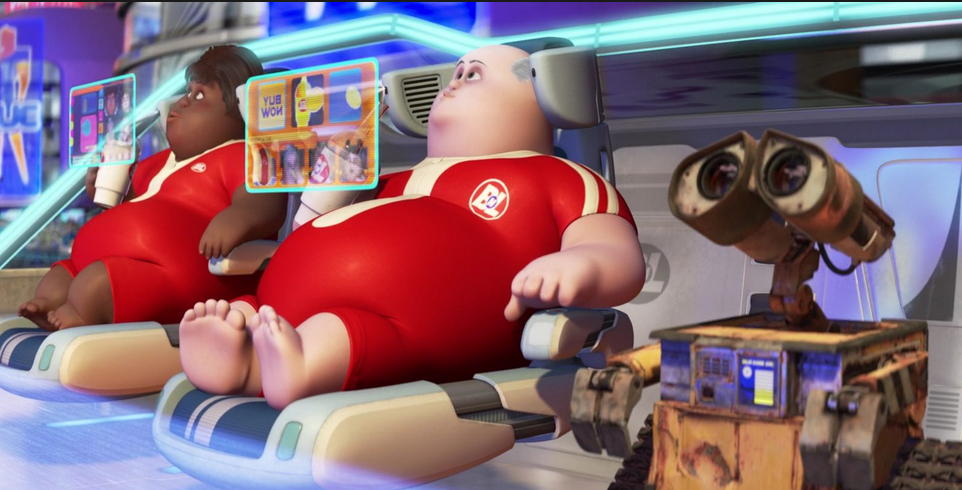
5. (Remember those pod people in Wall-e? *shudders*) (although I have to admit that I can imagine certain situations where I would be thrilled to have that service)(the seductiveness of convenience. I admit it gets me more often than I probably want to admit)


6. Probably the best thing about our lack of bookstore, though, is that it got me back into using our local library. My most frequent contact with them is through their downloadable materials website, where I can get books for my Kindle 24 hours a day. But every month or two, I go to the actual physical library. It fills some deep inner weird need of mine to wander around a place full of books, choose some I want, and take them home with me.

But the good news is I'm only borrowing them, so I haven't lost any money if I pick something I end up not liking, and I don't need to find shelf space for them. For the size of our town, we have an amazing library. Last week was National Library Week, so hats off to all the libraries out there. If you haven't been to yours in awhile, highly recommend a visit. It's not just books-- ours has a whole room full of DVDs and CDs, and there are rows of shelves of audiobooks for road trips.

7. Spring. Yep, that's my good news for the week. Like most of the northern half of the USA, our winter held on for far longer and with far more snow and wind and storminess than is usual. But it is finally spring. We are supposed to hit 60 degrees today, the grass is starting to turn green, the snow is gone--even the enormous piles where the snowplows were shoving it. I'm happy.

Hope you have a lovely spring weekend. Sorry this is late, I wrote the first half of it last night and then I was so tired I bailed.


Thursday, April 19, 2018

I have no idea what to call this. Dealing with disappointment, part 1, I guess. Except this may be all I have to say.

My dad was more-or-less a narcissist. By "more-or-less" I mean he was never diagnosed by a clinician, but he met the criteria as explained to me by more than one practitioner. When you're the child of a narcissist, there are a number of common problems you face (google "children of narcissists" for dozens of fascinating articles). But one that is not so often discussed is that narcissism is one of the things that you know, inside out. If you have the right personality, and apparently I do, it can lead to what one therapist defined to me years ago as the "narcissistic overlay."

If you have a narcissistic overlay, you're not technically a narcissist, but you have a way of dealing with the world that certainly looks and feels like narcissism, a way that you picked up without realizing it from living with a narcissist. Not all children of narcissists have this problem (for example, neither of my siblings do), but I did.

That therapist held my hand and helped me break through the narcissistic overlay, which was very difficult and painful at the time, but so worth it, because it's like a totally new life. You can feel and understand things that were, well, murky before. (And by the way, if this is a problem that you share, you'll only compound the problem if you react with self-judgment and self-hatred. It is what it is. You get out of it by accepting it and dealing with it.)

For years now I've been grateful to that therapist, but I thought I was done with it. I was grateful to him in the past tense, because wow, was it awesome that he helped me get rid of my narcissistic overlay.

But as I worked my way through my sense of failure and disappointment with my life, it became more and more clear to me that I haven't really finished dealing with it at all. A lot of the hopes and dreams that have not happened for me turned out to have, on further examination, that same sort of murky, ill-defined feel that the narcissistic overlay had.

For example: I always, my entire life up until about ten years ago, dreamed of being a novelist. But I discovered that I hated writing fiction. Every time I tried, I hated it. Writing here comes naturally to me, writing fiction felt like I was trying to pull out my fingernails by the roots.

But I still had this just-below-conscious idea that if I were a novelist, everyone would love me (narcissistic clue #1). And when I tried to define what level of writer success would have made me feel I had achieved my dream, it wasn't just getting a good story written down on the page. It was that everyone I know would love it (clue #2) and it would be a monstrous best seller (clue #3) and an enormous critical success (clue #4).

That's a bit of an exaggeration so you can see what I mean, but not much of one. In other words, it wasn't about writing at all. It was about hubris, about the black hole that underlies all narcissistic thought, that everything should be about me me me, and everything around me should feed the vast, unmeetable needs of my inner narcissist for approval and validation. Narcissistic goals aren't just simple statements of things you want to accomplish, they're hazy dreams of worship-inspiring success.

So step one for me in dealing with life disappointments has been learning to be very specific, very literal, about what exactly it is that I thought I wanted. What exactly would make me happy? What precisely is it that I wanted? Because when I can define it very carefully, very precisely, it often turns out that it's a) not something that I really care about after all (like writing fiction), or b) something that I've already accomplished but not given myself credit for (because I have written stories. I do write in this blog. I am a writer. I'm already there.)

N.B.: What is not included in this mental exercise is whether or not my dreams were/are realistic. It is the nature of dreams to be at least a little unrealistic, a little out of reach, a little crazy. I'm not worried about whether or not I could have "realistically" achieved my dreams. I'm talking about that endless need underneath, that ability that I have to inhale my smaller successes as if they were nothing, and to berate myself for not having achieved some huge other thing.

The reason I've been hesitating to post this is-- well, there are two reasons. One is that my disappointments are fairly small. I have not had to deal with the death of a child or spouse/partner, or their incarceration. I have not had to deal with bankruptcy or homelessness or prejudice. I'm not going to belittle my own heartbreak, but on the other hand, I'm not going to claim that what I'm dealing with is nearly the scale of what others are dealing with.

And secondly, I don't think that this particular aspect of dealing with disappointment and heartbreak is all that common. There probably aren't that many of us who have this hidden narcissistic need. I have no idea if this will resonate with a single one of my readers. But just in case it applies, this is step one: be specific. Get rid of the murk. Figure out what you really wanted underneath all the bluster. It may not be quite what you think.

(apologies about the weird gif, I don't know how to create them myself and that was the only one I could find that was clearly meant to be borrowed. Thank you to @anonymous who created it.)

Tuesday, April 17, 2018

brain antics

I've been thinking about my brain recently. I guess you can't really be objective about your own brain, so maybe this is just an exercise in futility. But I do think as I've gotten older I've learned how to deal with my brain a bit better.

Brains lie to us, you know. Your brain tells you that you'll be happy if you sit down in front of the TV at 7 o'clock every night and don't turn the TV off until 11. Your brain tells you that what you really need is a couple of glazed donuts with sprinkles. Your brain tells you there's no point in trying because you always fail anyway. Or maybe your brain says that if you're not on social media all day, Life will pass you by.

Or maybe you have a different kind of brain, the kind that tells you if you don't run five miles every other day you'll be a fat slob. Or if you order the wrong wine at a trendy restaurant, you'll never recover from the shame. Or if you let the dishes sit in the sink overnight you'll die alone. 

Everybody has lies they tell themselves. Sometimes they're lies that rationalize doing things we want to do anyway (like eating that donut). Sometimes the lies come from ideas we picked up when we were children (like there's no point in trying because you always fail). Sometimes our brains are just bored and want to be entertained (so watch TV for four hours every night).

I don't have a solution to this. Meditation helps because you start to see these things, these crazy things your brain is whispering to you all the time. But it doesn't really help you figure out what to do about them. At this very late date in my life, I'm finally learning to look at the results rather than listening to the lies. Does playing computer games for hours on end really make me happy? Do I feel good when I eat six cookies? Did the world stop when I couldn't find my phone and missed a bunch of stuff on social media?

Maybe I can grow up a little and figure out what I really need. Playing computer games for ten or fifteen minutes really does feel fun and relaxing for my brain when I need a break from something I've been working on. But if I'm still sitting there an hour later, I'm usually frustrated and mad at myself for wasting time.

Maybe a little forethought, a little intentionality is required. Figuring out what I really want instead of what my brain is telling me I want. (Which of course involves using your brain. This doesn't exactly make sense.)

(and p.s. of course there are times when zoning out in front of the TV for hours is exactly what you want/need to do. Or eating the donut, or going for a run, or whatever. But sometimes it's not.)

This is a little bit related to the disappointment topic I brought up last week, believe it or not. I got sidetracked into this one while I was thinking about that one. More soon.
 

Friday, April 13, 2018

7ToF: Where do you stand on Facebook?

1. Today's topic is Facebook. I know that some of you have never succumbed, so this may bore you to death. But I was in from the start-- I thought it sounded like fun. Facebook had only just opened up to people who weren't students when I joined. I eventually coerced all my family members to sign up, because I could share photos of the grandkids without having to go to the photo store, get copies made, divide them up into envelopes, address them, make the dreaded trip to the post office, and mail them out. I loved it.

2. But fast forward ten years and it's a lot more complicated than it used to be. There are two separate issues if you ask me. For one thing, like Twitter, FB seems to bring out the worst in people. The problems facing us are complex, but we love, love, love the clever one liner (me included. I've liked --and "loved"-- my share of clever memes). Preferably accompanied by a line drawing of a woman in Victorian clothing languishing on a chaise lounge. (where did she come from, anyway?) I've read some thoughtful posts on FB, we all have, but I've also read a lot of reductionist, my-side-zings-harder-than-your-side memes that move us backward into polarized positions instead of forward into new ways of talking about issues.

3. And anyway, as soon as FB's sorting system figures out which "side" you're on, you no longer see anything but the posts you agree with. Unless they're posts contributed by people you're friends with, in which case you get exposed to a side of them you didn't know existed, because in person we're always too polite to argue about politics. It adds a whole new layer of drama to already complicated family dynamics.

4. You can, of course, lock down your FB feed so that you only see posts from the people you want, and only the people you want can see what you post. When I raised concerns about FB with some friends of mine last week, that was the response I got-- just go in and tighten up your privacy settings! You can unfollow someone's posts and still be friends with them! They'll never know! And you can. It's true.

5. But that doesn't solve the second problem. Modifying your privacy settings affects who sees your posts and what posts you see, but it does nothing about what Facebook is learning about you, every time you use it, and even when you're not. In an article for Bloomberg Gadfly, Shira Ovide states:
"In a survey conducted recently by Digital Content Next...a majority of respondents said they didn’t expect the social network to track use of non-Facebook apps to target ads, collect their physical location when they’re not using Facebook or harvest information from non-Facebook websites that people visit. Spoiler alert: Facebook does all of those things."
That's scary stuff. (Read the whole column here.)(And there's another interesting one here.)

6. I'm not worried enough to delete my account yet, but I've stopped using it. Maybe only temporarily, I'm not sure. I've never used FB to log into other apps, so I don't have to worry about that, but FB owns Instagram, which I do use. I never connected the two of them-- in fact, I went out of my way not to connect them-- but it happened anyway. Not long after FB bought instagram, Instagram knew who my FB friends were and started urging me to invite them to join.

7. In a way, it's kind of silly to worry about it. We got an Alexa device for Christmas, and you can read plenty of articles out there that will scare the bejeezus out of you about having an always-on microphone in your living room. But on the other hand, that's the future. Isn't that the way it is in just about every sci-fi TV show/movie/book out there? You talk to the computer, and the computer hears you and responds.
Star Trek Trivia: the voice of the computer in the original Star Trek series was provided by Majel Roddenberry, the wife of Star Trek creator Gene Roddenberry. She also played Nurse Chapel.
The Best Line (arguably) from Galaxy Quest: Sigourney Weaver as Gwen DeMarco, whose job it is to talk to the computer: "Look! I have one job on this lousy ship, it's *stupid*, but I'm gonna do it! Okay?"
And besides, how cool is it to be able to tell Alexa to turn on the lights when you walk into the room with your arms full of laundry? The kids can even turn on the lights over Skype by talking to Alexa when we call them on Sunday night. (yeah, we're easily entertained.)

I don't know what the answer is. But I do know that what I read about Mark Zuckerberg's testimony before congress didn't relieve my worries. If I come to any conclusions, I'll let you know.

Have a great weekend. We are planning on doing a whole lot of not much.

Tuesday, April 10, 2018

TBT: Midlife disappointment

It has ended up taking me longer than expected to get back to this, even though (for once) I do have a plan for my next topic.

Not long after I started this new blog--well, it was new back then, anyway-- I wrote a post about how being in your 50s means letting go of certain dreams/ideas/plans that just aren't going to happen. At the time, I made it sound like I had a better handle on it than I actually did. It's something I've been working on for a long time. I'm making a little progress. So that's going to be my next topic, but I haven't had time to sit down and write it out yet, so in the meantime, here is the link to the original post, which was in April of 2015:

I could not travel both and be one traveler